

IDRA Analysis Finds Charter Schools Lose 44% of Black Students
Key Takeaways
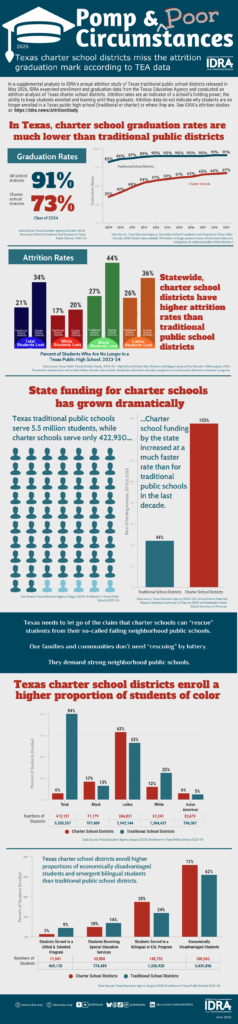
- Charter school districts served 6% of Texas students but accounted for 18% of student dropouts in 2023-24.
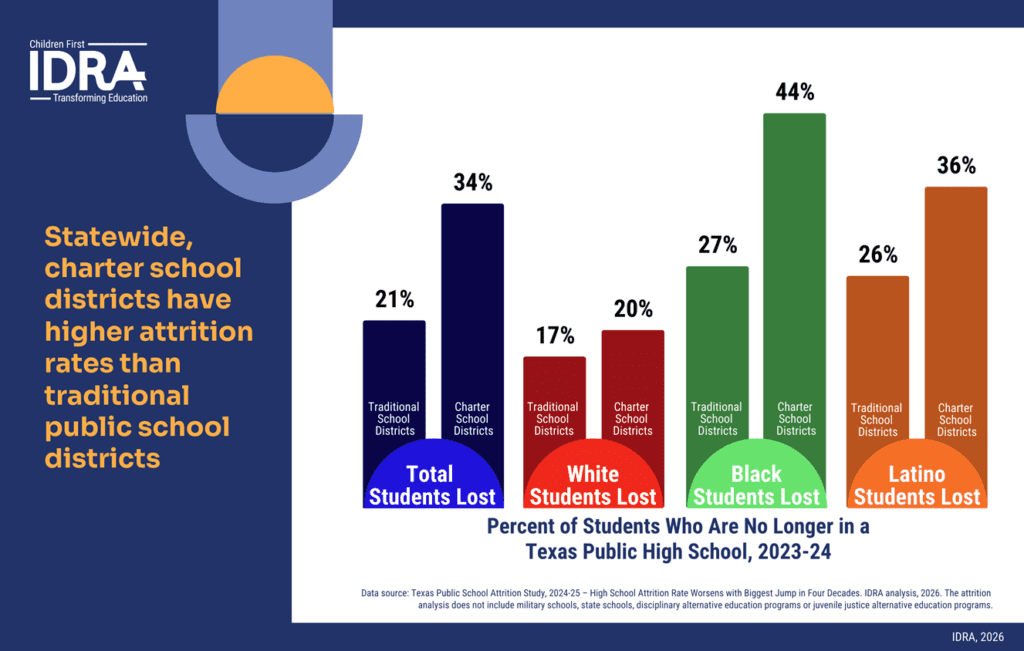
- Charter school districts lost one in three students to attrition compared to one in five lost by traditional public schools.
- IDRA found that charter school districts had an attrition rate of 34% for the Class of 2024, compared to 18% for traditional public school districts.
- Charters lose 44% of Black students, followed by 36% of Latino students and 20% of white students.
- The Texas Education Agency reports a nearly 17% four-year dropout rate for charter school students in the Class of 2024, which is almost three times the statewide rate for all students.
San Antonio (June 10, 2026) – Texas charter school districts continue to lose students at substantially higher rates than traditional public schools, according to a new analysis by IDRA. While charter school districts served just 6% of Texas students in 2023-24, they accounted for 18% of students who dropped out of school.
The report also cites state data finding that the annual charter school dropout rate was more than triple the statewide rate and that charter schools lost one in three students from the Class of 2024.
State funding for charter schools grew 155% over the last decade, compared to 44% for traditional public schools.
San Antonio (June 10, 2026) – Texas charter school districts continue to lose students at substantially higher rates than traditional public schools, according to a new analysis by IDRA. While charter school districts served just 6% of Texas students in 2023-24, they accounted for 18% of students who dropped out of school.
The report also cites state data finding that the annual charter school dropout rate was more than triple the statewide rate and that charter schools lost one in three students from the Class of 2024.
State funding for charter schools grew 155% over the last decade, compared to 44% for traditional public schools.
“All students deserve an education that prepares them for the real world and sets them up for success,” said Celina Moreno, J.D., IDRA president and CEO. “IDRA’s findings point to a need for greater transparency and continued monitoring of student outcomes as charter school expansion continues across the state.”
The findings are part of a charter school analysis included in IDRA’s Texas Public School Attrition Study, 2024-25. Each year, IDRA examines high school attrition as an indicator of a school’s holding power, or its ability to keep students enrolled and learning through graduation. Using the same methodology employed in its annual statewide attrition study, IDRA examined student retention and attrition patterns in charter school districts across Texas.’
Key findings include:
- Charter school districts are losing one in three students to attrition compared to one in five lost by traditional public school districts.
- IDRA found that charter school districts had an attrition rate of 34% for the Class of 2024, compared to 18% for traditional public school districts.
- Charter school districts lose 44% of Black students, followed by 36% of Latino students and 20% of white students.
- The Texas Education Agency reports that charters had a four-year dropout rate of nearly 17% for the Class of 2024, which is almost three times the statewide rate for all students.
The analysis found that attrition rates varied across Texas counties but remained consistently higher in charter school districts than in traditional public school districts. Attrition data do not indicate why students are no longer enrolled in a Texas public high school (traditional or charter) or where they are. While Texas does use “leaver codes” to attempt to report where students go when they leave school, some data are not verified, and the largest category, other than “graduation,” is “unknown reasons.”
See the charter school analysis in the Texas Public School Attrition Study, 2024-25. IDRA is the only organization that has consistently tracked Texas high school attrition for 40 years.
Media Contact: Thomas Marshall III, M.Ed., IDRA: thomas.marshall@idra.org.
Quick Links to IDRA’s Attrition Study Stories and Resources
Analysis article: Dropout Rate for Texas Charter Schools Triples the State Rate – IDRA Attrition Analysis Shows Charter Schools Lose 44% of their Black Students, by Christina Quintanilla-Muñoz
Infographic: Pomp and Poor Circumstances – IDRA Charter School Study 2026 – Infographic
Attrition Study 2024-25: Texas Public School Attrition Study, 2024-25 – High School Attrition Rate Worsens with Biggest Jump in Four Decades
Infographic: Texas Public School Attrition 2024-25
Infographic: 8 Types of Dropout Data Defined
Infographic: 6 Policies and Practices that Lead to Higher Dropout Rates
Infographic: A Legacy of Valuing Students
Trend graphs: See attrition rates and numbers over 10 years
Quick Links to IDRA’s Attrition Study Stories and Resources
Analysis article: Dropout Rate for Texas Charter Schools Triples the State Rate – IDRA Attrition Analysis Shows Charter Schools Lose 44% of their Black Students, by Christina Quintanilla-Muñoz
Attrition Study 2024-25: Texas Public School Attrition Study, 2024-25 – High School Attrition Rate Worsens with Biggest Jump in Four Decades
Infographic: Pomp and Poor Circumstances – IDRA Charter School Study 2026 – Infographic
Infographic: Texas Public School Attrition 2024-25
Infographic: 8 Types of Dropout Data Defined
Infographic: 6 Policies and Practices that Lead to Higher Dropout Rates
Infographic: A Legacy of Valuing Students
Trend graphs: See attrition rates and numbers over 10 years
Frequently Asked Questions
What is the charter school attrition rate in Texas?
IDRA found that Texas charter school districts had an attrition rate of 34% for the Class of 2024. This means about one in three students who entered charter schools as freshmen were no longer enrolled by the time their class graduated. Traditional public school districts had an attrition rate of 18%.
How many Texas students attend charter schools?
According to Texas Education Agency data, charter school districts served about 6% of Texas students in 2023-24.
How does the charter school dropout rate compare to the statewide rate?
The Texas Education Agency reported an annual high school dropout rate of 6.3% for charter schools in 2023-24. The statewide rate for all students was 1.9%.
What did the analysis find about student groups?
IDRA found that charter school districts lost 44% of Black students, 36% of Latino students and 20% of white students from the Class of 2024.
What does attrition mean?
Attrition measures the percentage of students from a freshman class who are no longer enrolled by the time that class reaches its expected graduation year. It is an indicator of a school’s holding power, or its ability to keep students enrolled and learning through graduation.
What does “lost” mean?
“Lost” means they were not in a Texas public high school by their senior year, and Texas does not know with any certainty where they are.
Does attrition show why students left school?
No. Attrition data show that students are no longer enrolled but do not identify why they left school or where they went. While Texas uses “leaver codes” to attempt to report where students go when they leave school, some data are not verified, and the largest category, other than “graduation,” is “unknown reasons.”
How long has IDRA studied attrition in Texas?
IDRA has tracked Texas high school attrition rates for 40 years and is the only organization that has consistently conducted this statewide analysis.