

IDRA Releases Student-led Research Report on School Discipline
(Atlanta • February 26, 2026) Nationally, Black girls are consistently the most over-disciplined compared to girls of all racial groups. Students in the Atlanta area describe how harsh discipline hurts Black girls’ chances of future success in school and in life. These are among the findings of a youth-led research study supported by IDRA. IDRA just released the students’ report: Listen to Us! – Black Girls Speak Out on Biased Discipline and Its Impact in Atlanta-Area Schools.
High school students, Nickell Brown, Natiyya Carswell, Betzayda Domingo and Eden Frazier examined the school discipline experiences of Black girls in Atlanta-area schools.
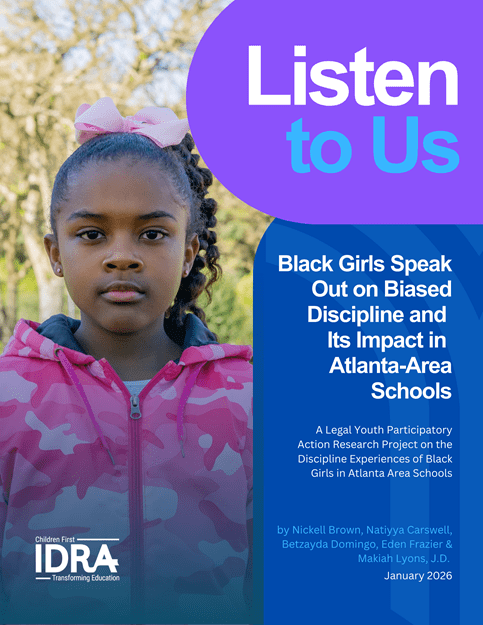
“Schools should be a place where all students feel safe and supported, no matter what,” the team wrote. “But unfortunately, this is not the case for all students.”
With youth participatory action research (YPAR) as the guiding framework, this project added a legal element to consider the civil rights issues students may face regarding school discipline.
An IDRA staff attorney, Makiah Lyons, J.D., advised the student researchers as they reviewed national and regional data. IDRA trained the team in research methodology, and they held a focus group to hear directly from Black girls in Atlanta-area public schools about their experiences.
Across all participants, girls expressed mistrust in teachers, school leaders and the broader school system due to the repeated mistreatment experienced at school. One student in the focus group said, “I feel like they don’t actually really care about anything that we feel or have to say.”
Three themes emerged connecting students’ experiences with discipline practices at their schools.
- School staff and administrators often exhibit bias or engage in unfair treatment when addressing behavioral concerns.
- Exclusionary discipline practices harm students’ social, emotional and academic well-being.
- Exclusionary and punitive discipline practices perpetuate hostile or unsafe environments for learners.
The student researchers proposed an array of solutions to ensure that Black girls do not continue to be unfairly disciplined and are supported in their school environment. Recommendations include a call for policy changes to remove subjective language and ensure that exclusionary discipline is used only as a last resort. The girls also urge better support for educators through teacher training in conflict resolution and de-escalation skills.
The Safety, Dignity and Belonging project was made possible with the generous support of Equal Justice Works.