
Education Law Center Report Shows Poor School Funding Across the U.S. South
(December 11, 2025) Texas received a failing grade for school funding, and Georgia was not better, scoring a D, according to a new report released by the Education Law Center. Making the Grade: How Fair is School Funding in Your State? is the latest contribution to the ELC’s decade and a half series of annual reports on school funding fairness.
This year’s version warns that many states are not fairly funding their public schools, “while the Trump administration’s threats to reduce federal education funding and dismantle the U.S. Education Department would contribute to weakening equity in nearly all states.”
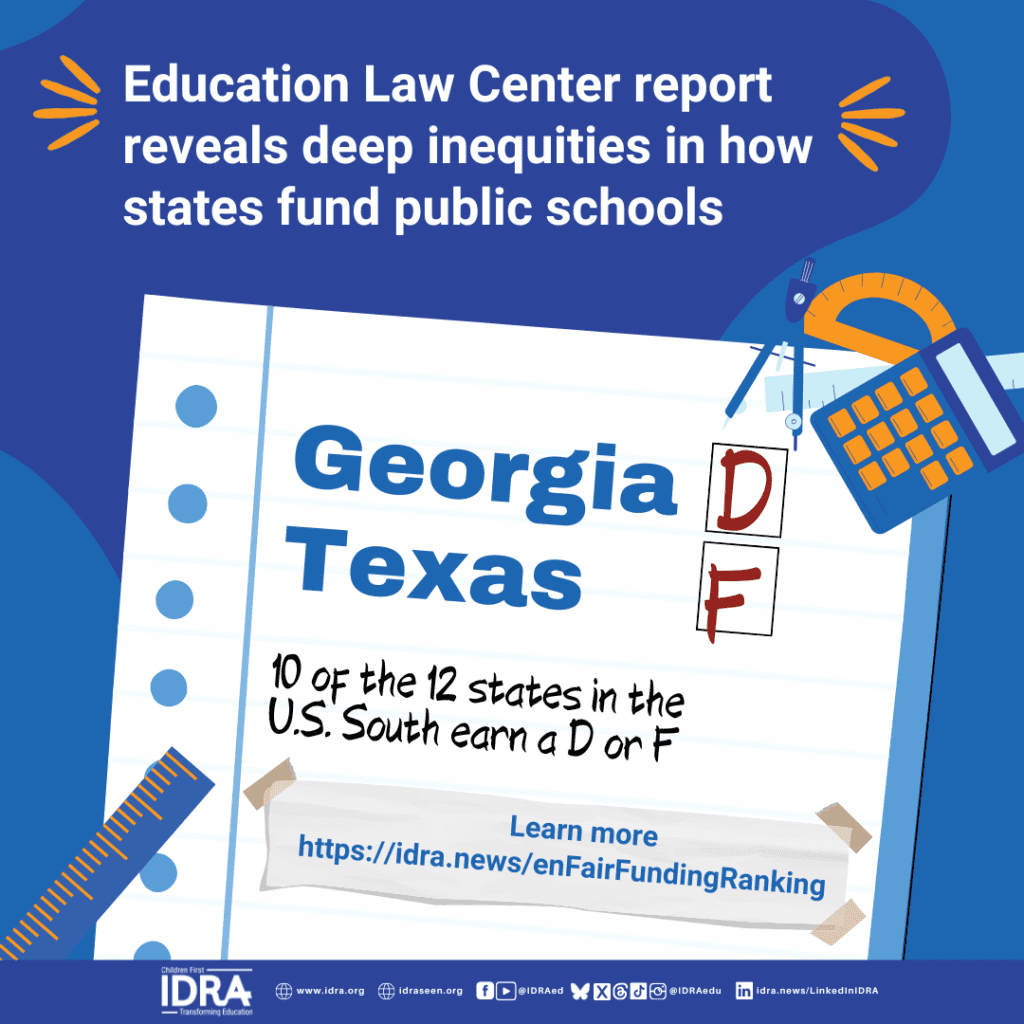
The report found that 10 of the 12 states in the U.S. South received a D or F.
“This report reminds us that the devil of fair school funding is in the details,” said IDRA Deputy Director of Policy Chloe Latham Sikes, Ph.D. “Fairness depends on states directing funds equitably so that all students have a fair shot.”
“Unfortunately, students facing the most poverty still experience schools with the least funding,” she added. “This report shines a light on the steps policymakers must take to make sure every student has a well-funded education.”
What grades did your state receive? Find out here.
Making the Grade 2025 evaluates each state’s education funding system on three critical measures of fairness: funding level, funding distribution and funding effort.
Key takeaways from the report, which covers the 2022-23 school year, include:
- Not a single state earned a grade of A on all three funding fairness indicators.
- California’s investment in a new, more equitable school funding formula is paying off: The state dramatically improved all three measures and now has the second most progressive funding distribution in the nation.
- Several states have high average funding levels but flat or regressive distribution, necessitating school finance reforms to better allocate revenue according to student need (Connecticut, Illinois, Maine, Michigan, New Hampshire, New York, New Jersey, and Pennsylvania).
- Of the 19 states that earned a D or F grade on funding level, 13 also earned a D or F on effort. These states are not leveraging their economic capacity to better fund schools.
- Florida, Idaho, and Tennessee have the unenviable distinction of earning Fs across all three indicators.
This year’s report also evaluated the contribution of federal revenue to funding equity, both within and between states.
IDRA advocates fair school funding policies in Texas, Georgia and federally. In the upcoming Georgia legislative session, IDRA will focus on supporting additional funding for students living in poverty.
In Texas, the new school funding law via House Bill 2 invested in specific program and outcomes-based funding but left the per-student base funding relatively unchanged. See IDRA’s Ensuring Fair School Funding for All Students webpage to get research briefs, summaries of new school finance laws, information on the harms of private school vouchers and interactive data dashboards.
Making the Grade 2025 is co-authored by Dr. Danielle Farrie, ELC research director, and Robert Kim, ELC executive director. View the full report and explore findings with interactive tools online, including downloadable state profiles.