
September 30, 2026
Students have long used their voices to influence schools, public policy and democracy. IDRA and SEAT discuss student protests and advocacy, constitutional free speech protections, Tinker v. Des Moines and the challenges young people face when speaking out.
Key Takeaways
- Students retain constitutional free speech rights in public schools. Under Tinker v. Des Moines, schools generally cannot restrict student expression unless it causes a material and substantial disruption.
- Student advocacy takes many forms, from testimony to public protest. SEAT helps students advocate before school boards, state and federal policymakers, and university leaders, including through a symbolic funeral protesting restrictions on academic freedom.
- Schools should not favor one viewpoint over another. Applying rules differently based on the message students express can raise concerns about viewpoint discrimination.
- Student speech is part of civic participation. Protecting young people’s ability to express ideas and engage with issues supports their development as civic participants and their role in democracy.
Resource from the Intercultural Development Research Association (IDRA), a nonprofit advancing education equity.
Student activism has long shaped U.S. democracy, from the Civil Rights Movement to today’s advocacy around education, racial justice and free expression. Yet many students now describe a growing fear of speaking out, raising important questions about whether constitutional protections for student advocacy remain meaningful in practice.
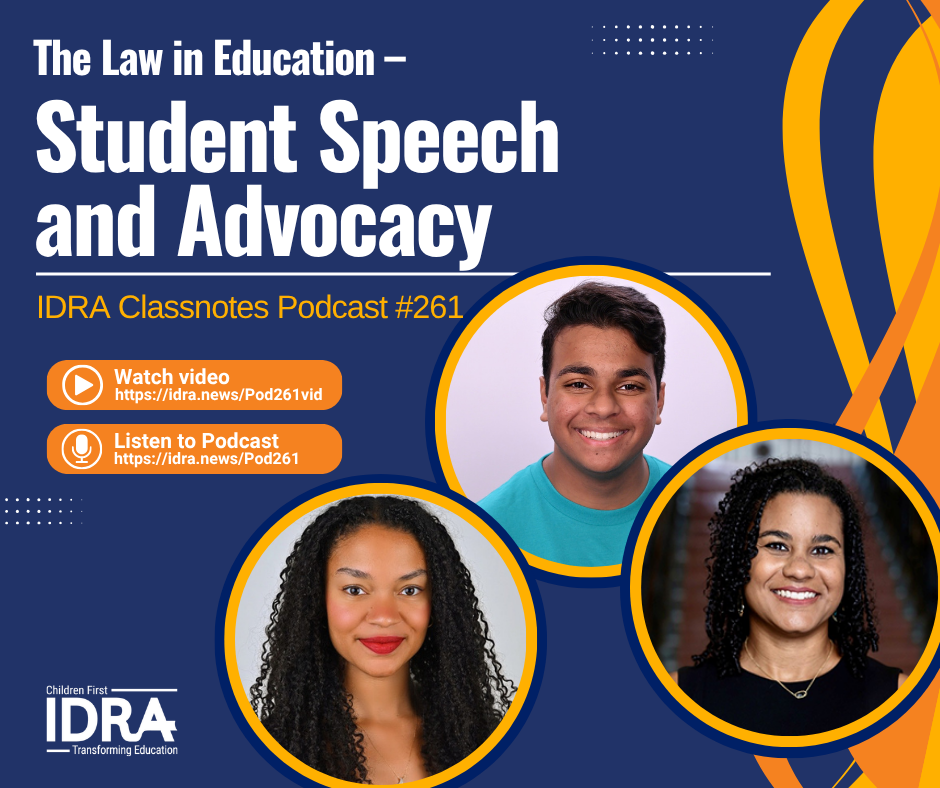
In this episode, IDRA summer law clerk, Ámbar Caldwell is joined by Ayaan Moledina of Students Engaged in Advancing Texas (SEAT) and IDRA Chief Legal Analyst Paige Duggins-Clay, J.D., to explore the changing landscape of student speech. They discuss the role of youth activism in shaping public policy, the constitutional principles established in Tinker v. Des Moines, the dangers of viewpoint discrimination, and how current federal and state policies are influencing student advocacy in K-12 schools.
The conversation also examines how students are experiencing today’s political climate, including concerns about disciplinary consequences, self-censorship and the broader implications for civic engagement. Ultimately, the episode asks whether schools continue to serve as places where young people learn to participate in democracy, or whether fear of retaliation is creating a broader “descent in dissent.”
Whether you are an educator, policymaker, student or advocate, this episode offers an important discussion about free expression, constitutional rights and the future of student voice in U.S. schools.
“We are pulling up our seat, we are pulling up our chair, and we are going to have that representation, whether we are asked to or not.” – Ayaan Moledina
“It’s scary, but we’re doing it because we know we have to, and because we know that if we don’t do it, nobody’s going to be able to represent our voice.” – Ayaan Moledina
“Students need to learn and express themselves freely in these environments. So, I think these are important things for students to know, how the law protects them when they’re doing that and when they’re experimenting with that, and they’re becoming the leaders of our country and our world.” – Ámbar Caldwell
“This is actually really, really important for young people’s development, for them to exercise civic engagement, and ultimately democracy.” – Paige Duggins-Clay, J.D.
Resources
Tinker v. Des Moines: Students’ Freedom of Speech – This educational resource from the U.S. Courts provides an overview of the landmark Supreme Court decision that established students do not “shed their constitutional rights to freedom of speech or expression at the schoolhouse gate.” It includes the facts of the case, the Court’s reasoning, and the decision’s lasting impact on student speech rights.
Tinker v. Des Moines Educational Resource
Students Engaged in Advancing Texas (SEAT) – a youth-led organization that empowers Texas students to advocate for equitable public education through organizing, leadership development, and civic engagement. Learn more about the organization and its ongoing advocacy efforts.
First Amendment and Student Speech – American Bar Association – The American Bar Association provides an overview of student free speech rights, including key Supreme Court decisions and how courts balance students’ constitutional rights with schools’ educational responsibilities.
Texas Senate Bill 12 (89th Texas Legislature) – Read the full text of Texas Senate Bill 12, which addresses parental rights, extracurricular activities, and restrictions related to diversity, equity, and inclusion in Texas public schools. The legislation is referenced in this episode’s discussion of the current K-12 policy landscape.
Show length: 36:38 min.
Send comments to podcast@idra.org
Sign up to receive free e-mail notices when new episodes are available.
Your feedback: We welcome your comments and questions to the podcast. Use IDRA’s online form, or send an email to podcast@idra.org
Listen to every episode! To ensure you don’t miss a single episode of IDRA Classnotes, subscribe to the podcast in iTunes and Spotify, or sign up to receive an e-mail alert as soon as a new show is published.