
Key takeaways
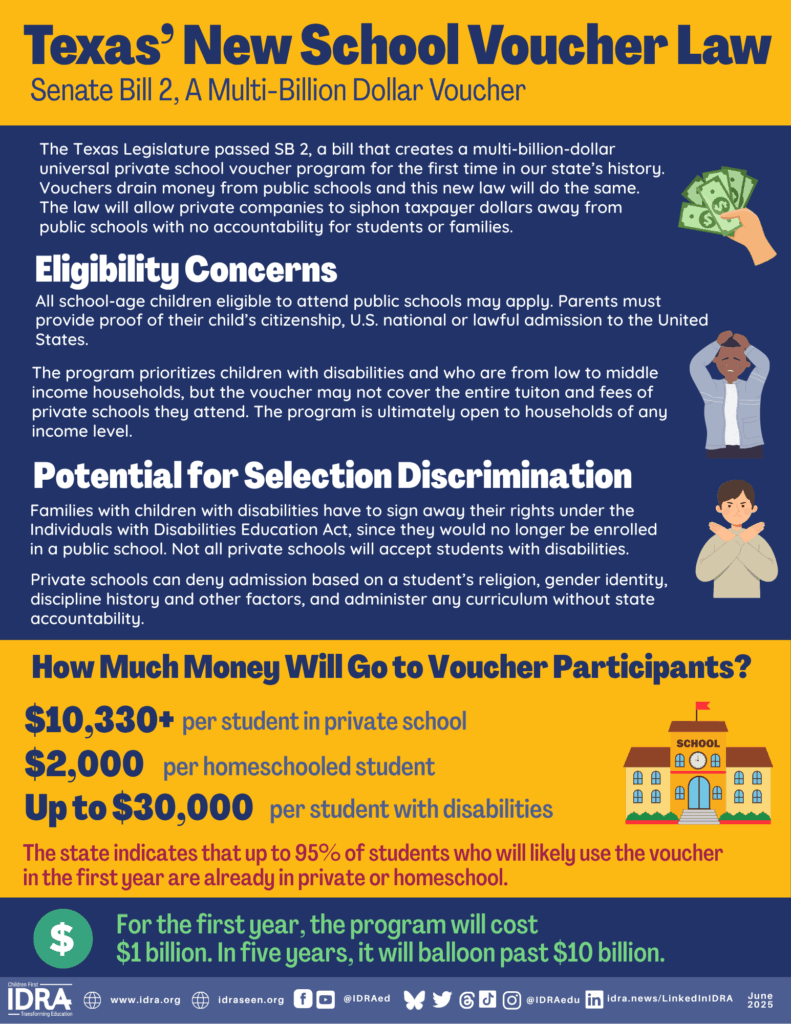
- Texas launched this week a universal private school voucher program with an initial $1 billion cost that is expected to grow.
- The program has no income or student-need eligibility caps, making it one of the largest voucher launches in the country.
- Texas leaders have signaled plans to opt into a federal tax credit voucher program beginning in 2027, which could divert billions more from public education.
- There are no clear requirements for reporting student academic outcomes in the Texas voucher program.
- Public schools, already facing funding shortfalls, may experience additional budget pressure as vouchers roll out.
(February 4, 2026) This week, the Texas private school voucher program goes live to families across the state. State leaders have touted the program as the largest “Day 1” launch of a school voucher program in the country, meaning it is open to households of all incomes, with the initial $1 billion price tag that is expected to grow. The Texas school voucher program is universal, meaning it has no caps on eligibility based on income or student need.
At the same time, the Texas Governor has signaled his intention to opt in to the federal school voucher program, which provides a dollar-for-dollar tax credit of up to $1,700 to individuals who donate to voucher providers called scholarship-granting organizations. That program will begin in 2027 and could funnel billions of dollars away from public education.
While we don’t yet know exactly how these programs will work together, we anticipate them to overlap. The state voucher program will likely be the primary platform through which Texas will manage the federal school voucher program.
Here’s What to Watch for as Private School Vouchers Roll Out in Texas
• Ballooning cost of the private school voucher program in the state budget. Other states with universal school voucher programs, such as Arizona and Florida, have experienced significant pressure on their state budgets. This has hurt the states’ ability to support other needs, such as water, utilities and public education.
• Need for clear data on how students in the program perform. Research on private school voucher programs across the country shows that students in these programs perform worse academically. Unfortunately, there are no clear data-reporting requirements for the Texas school voucher program regarding student performance and achievement. Texans deserve to know how their dollars are used and how well students are learning in this new program.
• Know who goes and who leaves. Texans deserve transparency over who enrolls in the school voucher program, who leaves, and who tries to enroll but is turned away. Research on other universal school voucher programs shows that most participating students were already in private schools to begin with, not making new choices from public schools. Private schools can deny admission to students based on their special education needs, the language they speak, their religion and other factors. Students who leave these programs also often face learning loss. The Texas program reporting should make clear who participates, who is denied admission, and who leaves the program and where they go.
• How private school vouchers impact public schools. Public schools serve the majority of Texas students. Many school districts are already operating under major budget constraints, primarily due to the state’s refusal to fund them appropriately, and have made hard decisions to close schools or consolidate to save money. As the voucher program launches, Texans need to watch how it affects their local public schools.
Public education is a public good.
Every child deserves access to a well-resourced, fully-funded public school, regardless of zip code, income, disability status or background.
IDRA calls on state leaders to fairly fund public schools and to pursue policies that expand opportunity by investing in the systems that serve most children in Texas.
To learn more, follow the new Texas Center for Voucher Transparency and IDRA for news, updates and information.
References
- Abrams, S.E., & Koutsavlis, S.J. (2023). The Fiscal Consequences of Private School Vouchers. Southern Poverty Law Center, Education Law Center, Public Funds Public Schools. https://pfps.org/assets/uploads/SPLC_ELC_PFPS_2023Report_Final.pdf
- Cowen, J. (2025). Ideology over evidence: The truth about vouchers and how they harm students. American Educator. https://files.eric.ed.gov/fulltext/EJ1485718.pdf
FAQs
What is launching in Texas this week?
Texas has launched a universal private school voucher program that enables families of all income levels to use public funds for private education.
How much will the voucher program cost?
The program begins with a $1 billion allocation, with costs expected to rise significantly over time based on participation.
How does the federal voucher program fit in?
Texas leaders have indicated plans to opt into a federal tax credit voucher program starting in 2027, which could operate alongside the state program and increase the diversion of funds from public education.
Are there academic accountability requirements?
No clear requirements exist for reporting student performance or learning outcomes for students using vouchers.
Who is most likely to use vouchers?
Research from other states shows that many voucher users were already enrolled in private schools before participating, rather than transferring from public schools.
Can private schools deny admission?
Yes. Private schools may deny students based on disability status, language, religion or other factors.
Why does this matter for public schools?
Public schools serve most Texas students and are already underfunded. Voucher expansion can increase financial strain, leading to school closures or consolidation.
Where can Texans follow updates?
Texans can follow updates from the Texas Center for Voucher Transparency and IDRA.