

November 17, 2026
Disciplinary alternative education programs are exclusionary education programs where students are sent for either state-mandated reasons or discretionary reasons. IDRA and Texas Appleseed discuss student experiences in DAEPs and how policymakers can ensure students receive due process rights during the disciplinary process.
Key Takeaways
- DAEPs have expanded beyond their original purpose. Texas established disciplinary alternative education programs in 1995, but many students now receive placements for discretionary violations unrelated to serious school safety threats.
- Students experience unequal disciplinary consequences. Black students and students with disabilities are disproportionately affected by exclusionary discipline, and researchers describe cases in which students facing racial harassment were punished for responding to bullying.
- Educational experiences vary widely. DAEP placements can involve limited individualized instruction, isolation from peers and difficulties transitioning back to regular classrooms.
- Parents need stronger due process protections. Families may have limited opportunities to participate in disciplinary decisions or challenge placements that disrupt their children’s education.
- Schools need alternatives to exclusionary discipline. Researchers recommend restorative practices, counseling, student support services, better-trained educators and stronger investments in public schools.
Resource from the Intercultural Development Research Association (IDRA), a nonprofit advancing education equity.
More than 30 years after the passage of the federal Gun-Free Schools Act of 1994 and the Texas Safe Schools Act of 1995, zero-tolerance policies and laws surrounding school safety continue to affect students’ access to education and undermine positive school climates.
Policymakers have attempted to address behavioral issues, gun violence and school safety through harsh disciplinary policies that remove students from their classrooms. But decades of research show that exclusionary discipline can harm children’s educational, emotional and mental health development, disproportionately affects students of color and does not necessarily make schools safer.
One example is the use of disciplinary alternative education programs (DAEPs) in Texas. Originally established to address serious disciplinary offenses, DAEPs increasingly receive students for discretionary violations that have little to do with school safety. Students can spend weeks or months away from their regular classrooms, often with limited educational support and opportunities to return successfully.
Building on IDRA’s previous research, IDRA and Texas Appleseed collaborated on a new study examining DAEPs through data analysis and focus groups with students, parents, educators and community advocates. The research documents troubling experiences with exclusionary discipline and identifies policy recommendations to better protect students’ educational opportunities. The report is expected to be published in the coming months.
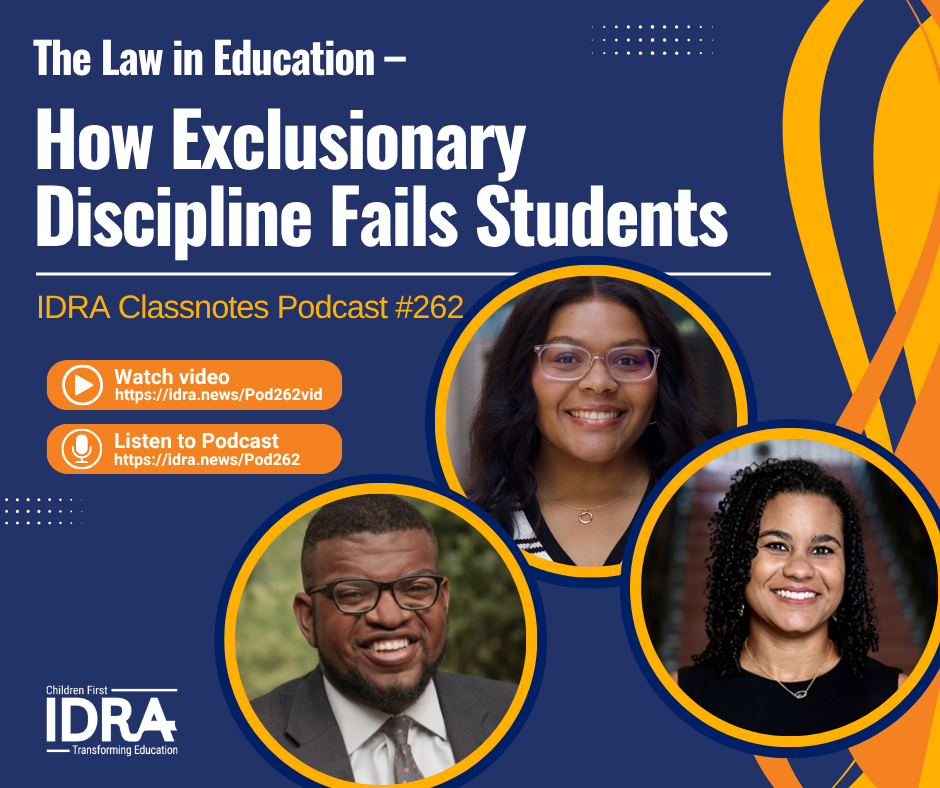
In this episode of The Law in Education series, IDRA Chief Legal Analyst Paige Duggins-Clay, J.D., former Texas Appleseed Education Justice Project Director Andrew R. Hairston, J.D., and IDRA education law intern Rachel Thompson discuss what the research revealed about students’ experiences in DAEPs. They also explore ways policymakers and schools can strengthen students’ due process rights, involve families in disciplinary decisions and replace exclusionary discipline with restorative, evidence-based approaches that support student success.
“We heard students describe DAEPs as morgues, for example. I’ll never forget the student who described walking into a DAEP facility and feeling like they were literally surrounded by dead people.” – Paige Duggins-Clay, J.D.
“It could be dress code violations, disorderly conduct, disruptive conduct, things that very much so are in the eye of the beholder and the particular administrator or teacher who is determining that this kid will go to a DAEP.” – Andrew R. Hairston J.D.
“For decades, policymakers have attempted to use harsh punishment and removal to address school safety concerns, and in particular, the rise in gun violence at schools.” – Rachel Thompson
“We have to stop blaming kids for policy failures and instead prioritize things that will help make the school environment safe for them, happy, welcoming and engaging.” – Paige Duggins-Clay, J.D.
Resources
End Harmful Use of Disciplinary Alternative Education Programs, webpage
The IDRA School Discipline – Online Technical Assistance Toolkit is designed to help school leaders and educators identify ways to proactively build safe and trusting communities and end their reliance on approaches to discipline that are harmful to students.
IDRA’s Interrupting Bullying & Harassment in Schools – Online Technical Assistance Toolkit gives educators and school leaders the tools that they need to prevent bullying and harassment by fostering a positive school climate. This package includes five chapters, each with a video and supporting resources.
Where Some Policymakers and School Leaders Get School Safety Wrong, IDRA, 2024
Restorative Practices Can Prevent and Heal Bias-based Harm, IDRA, 2024
Policy Roadmap – School Safety for All Students, IDRA, 2022
Discipline Policies Must Not Come at the Expense of Any Group of Students, IDRA, 2019
How Schools Can End Harmful Discipline Practices, IDRA, 2020
Stop the Bad; Do the Good – Hurting and Excluding Students Feeds the School-to-Prison Pipeline, IDRA, 2021
Transition Planning for Students in Alternative Education Programs, Disability Rights Texas, 2024
The Association Between Disciplinary Alternative School Placement and Youth Outcomes: A Meta-Analytic Assessment. Journal of School Violence, 2018
Zero Tolerance Policies in Texas Push Black Students and Latino Students Away from School – IDRA Web Story Released with the IDRA Attrition Study (Updated 2022)
Disciplinary Alternative Education Programs in Texas – What is Known?, IDRA, 1995
Disciplinary Alternative Education Programs in Texas – A 2009 Update, IDRA, 2009
Show length: 35:03 min.
Send comments to podcast@idra.org
Sign up to receive free e-mail notices when new episodes are available.
Your feedback: We welcome your comments and questions to the podcast. Use IDRA’s online form, or send an email to podcast@idra.org
Listen to every episode! To ensure you don’t miss a single episode of IDRA Classnotes, subscribe to the podcast in iTunes and Spotify, or sign up to receive an e-mail alert as soon as a new show is published.
FAQs
What is a disciplinary alternative education program (DAEP) in Texas?
A disciplinary alternative education program is an educational placement for students removed from their regular classrooms for certain disciplinary violations. Texas established DAEPs in 1995 as part of its school safety policies. Students may be assigned to DAEPs for mandatory or discretionary disciplinary reasons.
Why are disciplinary alternative education programs controversial?
Researchers and advocates have raised concerns about disproportionate disciplinary placements, inconsistent instructional quality, isolation from peers and limited opportunities for families to challenge disciplinary decisions. IDRA and Texas Appleseed have documented these concerns through research and conversations with affected students and families.
How do DAEPs affect students’ educational opportunities?
Students placed in DAEPs may receive instruction that differs substantially from their regular classrooms, including computer-based assignments and worksheets with limited individualized support. These differences can create academic challenges and make returning to regular classrooms more difficult.
Which students are disproportionately affected by exclusionary school discipline?
Research discussed in the episode identifies Black students and students with disabilities as among those disproportionately affected by exclusionary discipline. The speakers also discuss how racial harassment and other school climate issues can contribute to disciplinary referrals.
What rights do parents and students have during DAEP placements?
Texas law establishes disciplinary procedures for DAEP placements, but the speakers identify concerns about parents’ ability to participate meaningfully in placement decisions. They recommend stronger notification, parental involvement and review procedures to protect students’ due process rights.
What alternatives to DAEP placements do researchers recommend?
The speakers recommend restorative practices, counseling, behavioral interventions, multi-tiered systems of support and additional resources for educators. These approaches are intended to address student behavior while preserving access to classroom instruction and supporting student well-being.